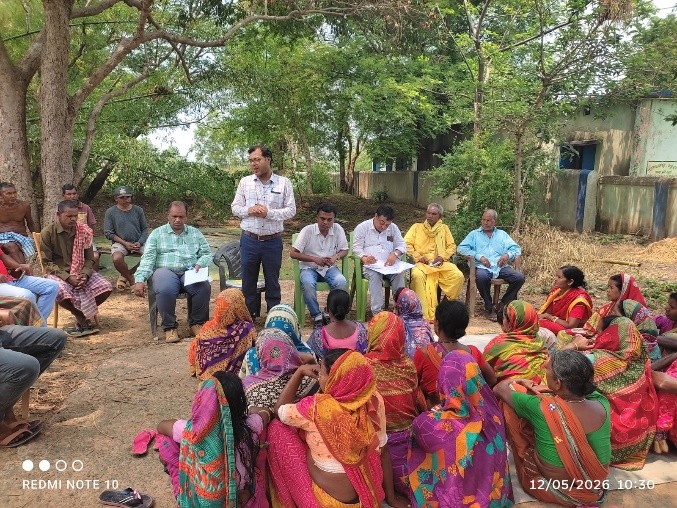
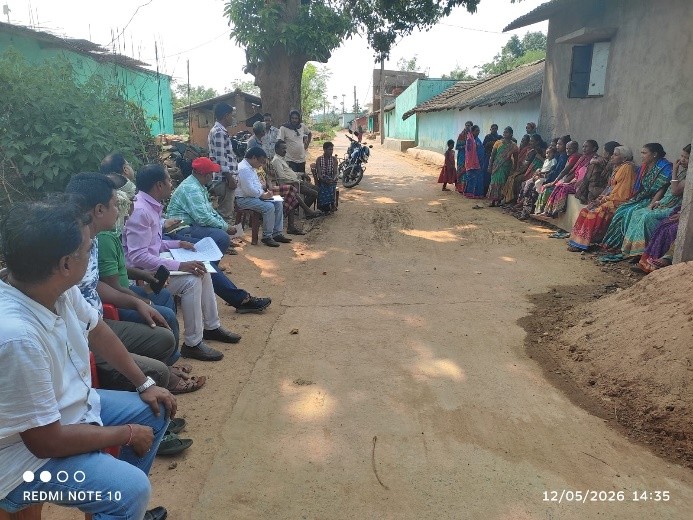
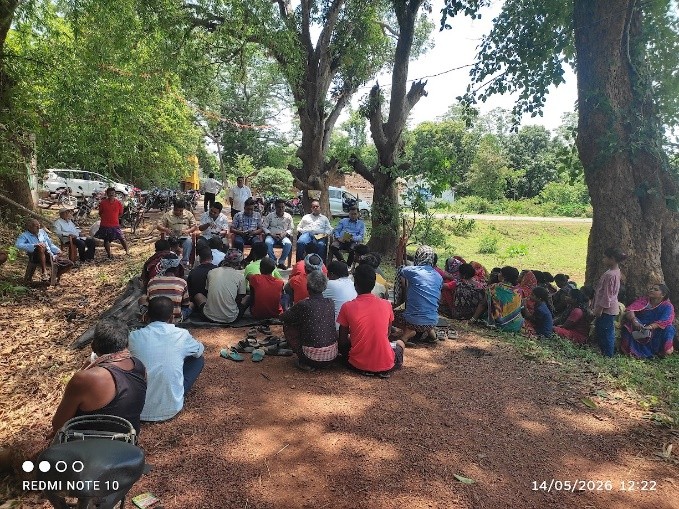
A team of scientists from the ICAR-Central Research Institute for Dryland Agriculture (CRIDA) successfully mobilised village committees across Godapalasa, Bhanjakia, and Tilokuti Gram Panchayats from 12.05.2026 to 14.05.2026. This collaborative effort, executed under the Odisha Agriculture Drought Mitigation Programme (OADMP) project, focused strictly on identifying and registering local farmers to adopt climate-resilient non-paddy crops and natural green manuring practices.
Supported by Raruan’s Block Agriculture Officer (BAO) and Block Technology Manager (BTM), the scientific team leveraged the deep local reach of respective village committees to conduct interactive meetings, map targeted land parcels, and establish a verified farmer database for direct input support.
The target villages currently depend almost entirely on continuous rice cultivation during the Kharif season.To break this cycle, ICAR-CRIDA is driving crop diversification specifically in vulnerable upland areas by working through village committees to identify interested cultivators to serve as models for adoption by other farmers in their villages. These registered farmers will transition from paddy to climate-smart alternative crops, including pigeonpea, groundnut, ragi, and maize.
Alongside upland crop shifting, the initiative focuses heavily on biological soil rejuvenation through Dhaincha cultivation in lowland paddy fields. Working hand-in-hand with committee members, scientists educated the identified farmers on utilizing pre-monsoon showers to sow this vital green manure crop.
Dhaincha naturally fixes atmospheric nitrogen. By mixing the crop back into the lowland fields at its peak vegetative stage (6 to 8 weeks), farmers will naturally restore soil fertility ahead of the main season. By working through village committees, the team has established a transparent, community-backed framework to distribute seeds and monitor field-level execution.
During the interactions, the scientific team emphasized the long-term economic benefits of establishing robust post-harvest infrastructure. Local self-reliance will be strengthened through decentralized mini-mills, community-led seed banks to permanently resolve local seed shortages, and Custom Hiring Centres (CHCs) that grant smallholders affordable access to critical machinery. To further maximize land utility, farmers will also be supported in planting high-value fruit trees—including mango, litchi, guava, and pomegranate—alongside dedicated timber plantation lines, creating secondary, long-term revenue streams for the region.